Expressvpn Glossary
Data acquisition
What is data acquisition?
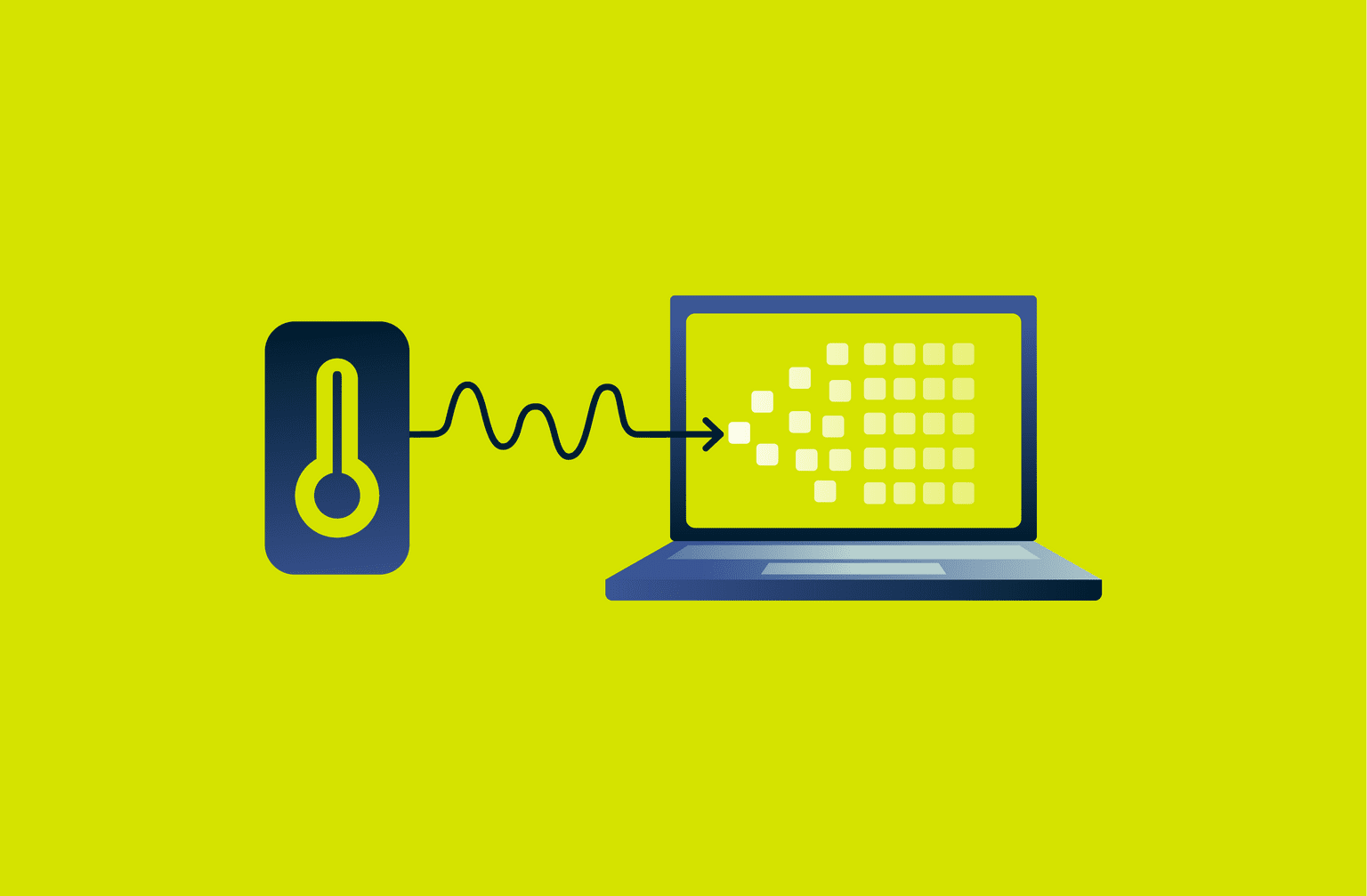
Data acquisition (DAQ) is the process of collecting data from physical systems. It can capture analog and digital signals, then send that data to a processing system. This data is typically used for monitoring, analysis, logging, and control.
How does data acquisition work?
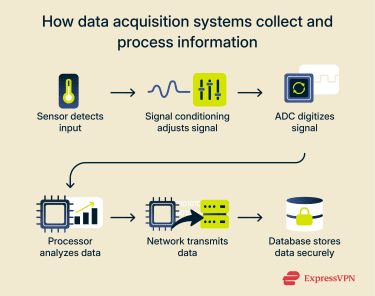
DAQ begins with sensors or transducers that detect physical conditions such as temperature, pressure, or motion. These devices produce either analog or digital signals that the DAQ system captures.
Analog signals pass through an analog-to-digital converter (ADC), which samples them at set intervals and converts them into digital values. Digital signals are read directly.
In both cases, the resulting data is sent to a computer or controller for processing.
Components of a data acquisition system
The components that make up a DAQ system include:
- Data source: Devices such as sensors and transducers that detect physical quantities and output analog or digital signals.
- DAQ hardware: Modules or cards that read incoming signals and capture logic states or pulses.
- Signal conditioning: Circuits that amplify, filter, isolate, or otherwise prepare signals so they remain accurate and safe to measure.
- Software: Tools that configure channels, visualize data, log measurements, and manage system operation.
- Storage: Systems that store acquired data, whether raw or processed, including local storage, data centers, and cloud services.
Why is data acquisition important?
Several factors make DAQ tools important:
- Real-time monitoring: Gives continuous visibility into equipment and process behavior.
- Better decision-making: Provides reliable data that supports analysis and optimization.
- Early anomaly detection: Highlights faults or drifts before they cause downtime.
- Automation and predictive maintenance: Supplies measurements that drive automatic control and maintenance.
- Support for AI and research: Delivers datasets for AI models and experiments.
Security and privacy protections
Acquisition systems need external privacy tools and configurations to remain secure. These include:
- Encryption: Protects measurement data by scrambling it so outsiders cannot read or alter it.
- Access controls: Authentication, authorization, and logging help prevent unauthorized changes and logins.
- Firmware and software updates: Outdated firmware or software can expose vulnerabilities that attackers might use to infiltrate a network and move laterally through it.
- Isolation: Keeps measurement circuits electrically separate from the rest of the system. This reduces noise, prevents damage, and limits the impact of accidental or malicious signal interference, although isolation doesn’t eliminate interference entirely. In high-precision systems, circuits can still affect each other through electromagnetic interference and capacitive, inductive, or radiative coupling, which engineers must manage through careful design.
Common applications
Real-world uses include:
- Industrial automation and equipment monitoring: Acquisition systems feed real-time data such as vibration, pressure, temperature, and power usage into control systems, which helps automate processes and detect equipment issues early.
- Smart homes and Internet of Things (IoT) networks: They use sensors to manage lighting, energy use, and security systems found within a typical IoT home.
- Environmental and weather tracking: These systems measure air quality, temperature, humidity, and precipitation and are often used to study long-term environmental trends.
- Healthcare device monitoring: These systems capture physiological signals such as heart rate, electrical activity, or respiration for clinical analysis.
- Research and laboratory experiments: Researchers use acquisition systems to record precise measurements in scientific and engineering studies.
 Support Center
  FAQ
FAQ  VPN Setup Tutorials